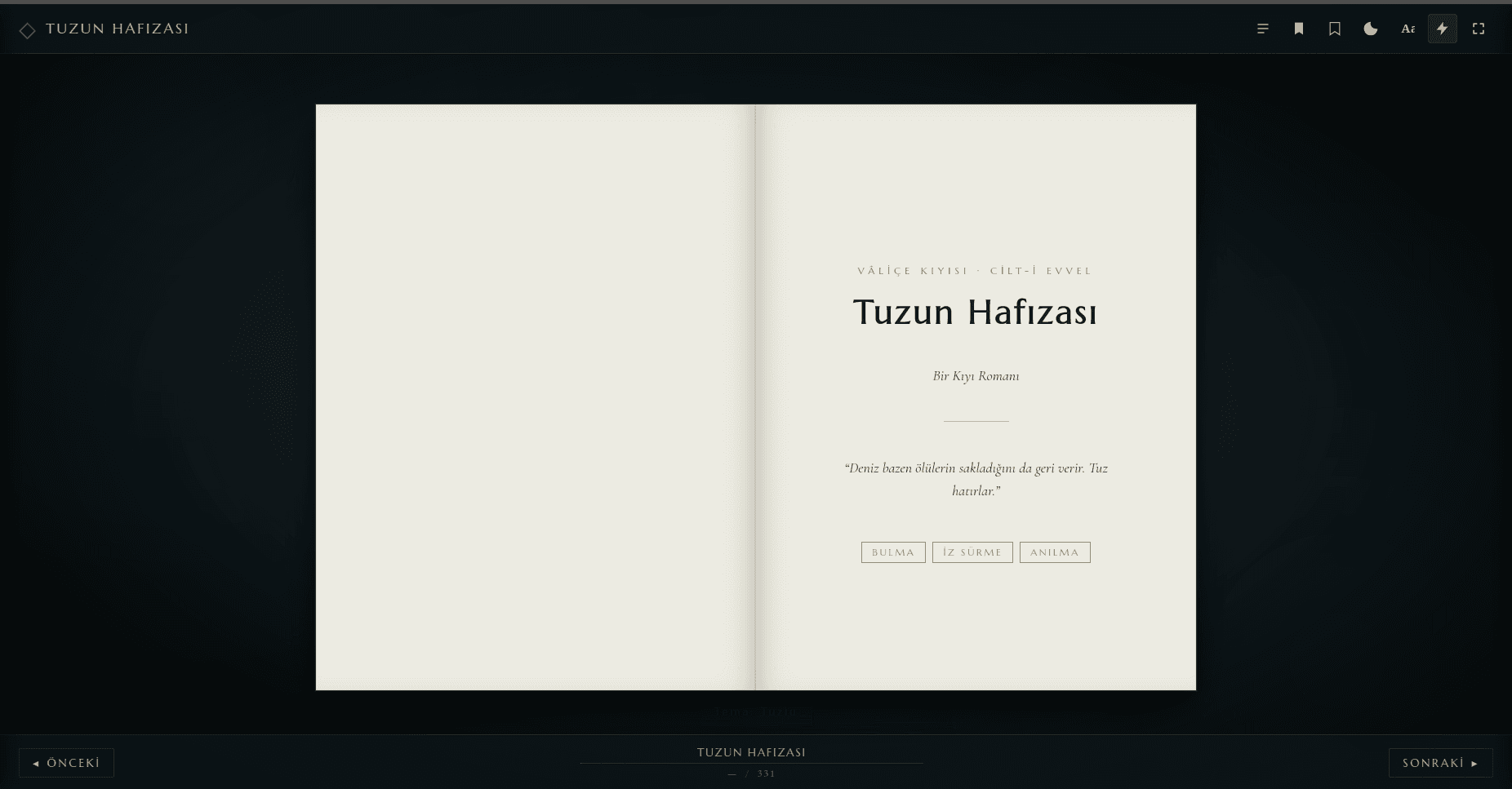
Tuzun Hafızası
Vâliçe Kıyısı · Cilt-i Evvel — Bir Kıyı Romanı
Deniz bazen ölülerin sakladığını da geri verir. Tuz hatırlar.
Atmospheres
Themes
Synopsis
Tuzun Hafızası is a literary coastal novel set in the early years of a republic that buried the empire it inherited from. In the town of Vâliçe — a small Aegean-Mediterranean fishing port where the salt-coast folklore still half-believes that those who die at sea leave a single grain of memory behind — Reha Sezerân returns for her father's funeral. In the half-ruined family salt-house, sealed since the typhus summer of her sixth year, she finds a grain her family has no record of owning. Placed on the tongue, under an oil lamp, the grain holds a child's voice she does not remember: abla, abla, koş. The voice belongs to a sister the imperial registry filed out of being.
The novel is a literary mystery dressed as a coastal chronicle — thirty-six chapters across three acts (Bulma · İz Sürme · Anılma), tracking how a librarian uses bureaucratic patience to dig through a folkloric brotherhood's wreckage and a new republic's tactful forgetfulness. The Salt Brotherhood — Tuzcular Tarikatı — once kept the country's quietest registry, reading what the sea returned. The Imperial bureau called Düzeltme — the Corrections — once unmade selected names from official record and burnt the corresponding grains; Reha's father sat on its local committee. The republic does not formally continue the program, but it also does not stop the burning. The argument the novel never speaks aloud: to name a missing person is itself a small, dispersed, never-finished act of remembrance — and a state can erase that act but cannot finish erasing it.
Shipped as a static, zero-dependency single-page digital codex. Pure vanilla JavaScript and CSS — a measurement-driven paginator, a 3D rotateY page-turn with curl shadow on capable devices, three CSS-token themes (tuzlu / kumlu / gece-deniz — coastal evening, limewashed daylight, lapis night-sea), a per-page bookmark system (izler), localStorage persistence for progress and traces, keyboard navigation, performance mode, and body type set in Cormorant Garamond and EB Garamond with Marcellus on the display. Five chapters of the thirty-six are currently bound into the live reader; the canon for the remaining thirty-one is fixed.
Narrative Constellation
Tuz — the axis everything else orbits.
- Tuz. Salt — the grain in which a dying memory crystallises. Reading it is a discipline, not a magic system. Drag to rotate · scroll to zoom.
- Sezerân Hânesi. The librarian's natal family. Two decades of taught forgetting; a sealed salt-house in the back garden.
- Halife Hânesi. The mother's natal family. A Halife was the brotherhood's pîr and was killed for it; a scholar in Kerâli now keeps the line on paper.
- Tuzcular Tarîkâtı. The Salt Brotherhood. Half-folkloric, half-clerical — Çırak, Tuzcu, Ustakadı. A discipline of reading what the sea returns.
- Yeni Cumhuriyet. The new republic. No formal continuation of the corrections, and a quiet, ongoing destruction of the older salt stocks.
- Defter-Hâne. The bureaucratic registry. Half-burnt during the collapse; the surviving ledgers under republic seal. The burnt section was not an accident.
- Düzeltme Komitesi. The imperial Corrections office. Selected the names filed out of being; the salt grains were burnt to match.
- Reha. Returning librarian, twenty-four. First in the household to taste a grain since the typhus summer eighteen years ago.
- Defne. Reha's four-year-old sister. Died one summer; was filed out of the registry within months. Her voice is the inciting grain.
- Mâra. The mother, fifty-two. Twenty-eight years of practised forgetting; will die before the third act ends with the name she was never allowed to say.
- Erol. The father, deceased. Sat on the Düzeltme committee in the second-phase years; signed off on the cancellation of his own daughter.
- Lemi. Salt-master of the Tuzhane, sixty-two. The last man in Vâliçe who can still teach the reading. Practical, anti-mystical, careful.
- Nahide. Apprentice, fifteen. Born the year of her own mother's correction; will be the one Reha leaves the inheritance to.
- Cilâl. The scholar uncle in Kerâli, fifty-eight. Spent thirty years on a Halife genealogy he was never asked for. Tells Reha who Defne was.
- İlhan. Captain of the republic's garrison, thirty-five. Childhood friend; lost his own mother to a late-empire raid. Decides whether to continue the burning.
- Çile Ana. Half-mythical founder. A coast-woman who lost her son and husband at sea and found the first grain in the tide. Taught what she did not understand.
- Mâriye Halife. The brotherhood's last formally registered pîr. Killed in one of the early Düzeltme sweeps for refusing to surrender the central registry.
- Rüh-Çizgi. The soul-line in a grain — a pale strand visible only in lamplight. Reading it gives a few seconds of the last sense: a hand, a smell, a child's voice.
- Tuzhane. The half-ruined Salt-house on Vâliçe's western shore. Still ayakta. The last working bench in the town; Lemi's, until it isn't.
- İptal Defteri. The cancellation folio. A signed, sealed document recording each name corrected out of being; the local copy of one folio sits in the Defter-Hâne archive.
- Vâliçe Kıyısı. The coast itself. A small Aegean-Mediterranean fishing port; the geography is the novel's inner voice. Salt washes ashore one grain at a time.
Chronicle
- Çile Ana mirası·First Stratum — the salt origin
A woman who lost her son and husband at sea finds a grain in the tide that holds her son's last grip on a rope. She teaches the coast what she does not understand. Her grave is unknown — some say she carried into the tide.
- Geç İmparatorluk·Mâriye Halife is killed
An accomplished Salt-master in the central provinces is taken in one of the early Düzeltme sweeps. The brotherhood loses its formal pîr; the practice continues quietly along the coast, no longer centrally registered.
- Düzeltme'nin İkinci Evresi·The Corrections accelerate
The Imperial registry — Defter-Hâne — formalises the erasure of names. Selected dead are filed as never-having-been; the corresponding salt grains are dissolved or burnt. Erol Sezerân sits on the local committee.
- Yaz — adı verilmez·Defne is filed out of being
A typhus summer kills a four-year-old girl in the Sezerân house. Her name is corrected from the registers. Her sister, six years old, is told she has no sister and is given enough time to learn to believe it.
- Çöküş·The Empire dissolves
A war, an economic crisis, and an inner collapse together. The bureau slows. The Corrections are not formally rescinded — they are simply unmanned. The salt-house in the Sezerân back garden stays locked.
- Cumhuriyet'in birinci senesi·The new republic founds itself
Headed by men who had served the empire's reforms. Bureaucratic order and political stability are named the priorities. The corrections continue, less systematic, under different paperwork; the older salt stocks are still burnt.
- Ekim — Cumhuriyet'in 3. senesi·Reha returns to Vâliçe
Her father's funeral. The salt-house in the back garden has not been opened in eighteen years. On a corner shelf she finds a grain with no family record. The voice she hears is too small to be anyone she remembers.
- Şubat — Cumhuriyet'in 4. senesi·The codex closes
Three small actions across three months: a name learned, a name spoken, a name left in another's drawer. The mother dies. The salt-master dies. The novel ends; the work of remembering does not.
Six Inheritances
Sezerân Hânesi
The librarian's natal family. A bürokrat-tüccar middle class deepened by two decades of taught forgetting; the salt-house in the back garden has been closed since the typhus summer.
Halife Hânesi
Mâra Sezerân's natal family. A Halife was the brotherhood's pîr and was killed for it in the early Düzeltme sweeps; the surviving Cilâl is a scholar in Kerâli who keeps the line on paper.
Tuzcular Tarîkâtı
The Salt Brotherhood. Half-folkloric, half-clerical — Çırak, Tuzcu, Ustakadı; never a magic-system, only ever a discipline of reading what the sea returns.
Düzeltme Komitesi
The imperial registry's correction office. Selected the names to be filed out of being; the local seat sat behind the Defter-Hâne, behind a green-baize door. Erol Sezerân's signature is on the folio.
Defter-Hâne
The bureaucratic registry building. Half-burnt during the collapse; the surviving ledgers are now under republic seal. The burnt section, smaller, was not an accident.
Yeni Cumhuriyet
Bureaucratic order, political stability, no formal continuation of the corrections — and a quiet, ongoing destruction of the older salt stocks, because the surviving grains are still witnesses.
Principal Figures
Reha Sezerân
Returning librarian, twenty-four.
Trained in the capital's archives. Comes home for her father's funeral and is the first in the family to taste a grain since the salt-house was sealed in the year of her sister's death.
Defne Mâriye Sezerân
The four-year-old, erased.
Reha's younger sister. Died of typhus in the summer of Reha's sixth year. Within months the registry had recorded her as never having existed; the household was told to stop saying her name.
Mâra Halife
Reha's mother, fifty-two.
Twenty-eight years married to a man on the Corrections committee. The taught forgetting has cost her in ways the body diagnoses last. Will die before the third act ends; her last word is the name she had not been allowed to say.
Erol Sezerân
Reha's father, deceased.
Sat on the Düzeltme committee during the second-phase years. The man who signed off on the cancellation of his own daughter and continued the work afterwards. Dies the autumn before the novel opens.
Lemi Akrâ
Salt-master of the Tuzhane.
Sixty-two. Trained under the brotherhood's last formally registered generation; the last man in Vâliçe who can still teach the reading. Practical, anti-mystical, careful. Will die in the third act, mid-lesson.
Nahide
Apprentice, fifteen.
Born the year of her own mother's correction. Brought to Vâliçe at seven. Has known nothing but the brotherhood; will be the one Reha leaves the inheritance to.
Cilâl Halife
Mâra's brother, scholar in Kerâli.
Fifty-eight. Spent thirty years on the Halife genealogy — including the line of Mâriye, killed for refusing to surrender the brotherhood's central registry. He is the one who finally tells Reha who Defne was.
Yüzbaşı İlhan Berhan
Captain of the republic's garrison.
Thirty-five. Childhood friend of Reha. Lost his own mother to a late-empire raid; is in the position of having to decide whether to continue the burning his predecessors began.
Three Acts
I. Perde · Bulma
- A funeral in Vâliçe. A father whose work the family never named. A salt-house in the back garden that has not been opened in eighteen years.
- A grain with no family record. An oil lamp in the storeroom. A child's voice the daughter does not remember: abla, abla, koş.
- A first attempt to ask who the voice was. A mother who answers in silence; a captain whose silence has different reasons than the mother's.
- The realisation that the wanting-to-remember is itself a position, and it has political shape.
II. Perde · İz Sürme
- A train to Kerâli. A scholar uncle who has spent thirty years on a genealogy he was never asked for.
- The salt-master Lemi takes the daughter into the trade because there is no one else left to be careful for.
- The republic's archive is opened twice — once with permission, once without. The second visit yields the registry's correction folio.
- An apprentice fifteen years old who has known nothing but the brotherhood, and who will inherit what the daughter is only now beginning to understand.
III. Perde · Anılma
- A mother dies on a January morning. Her last word is a name she had not been allowed to say in eighteen years.
- The salt-master dies mid-lesson. The apprentice is suddenly the only practitioner in the town.
- The daughter writes a small book — a single name, repeated — and leaves it in the desk drawer of a teacher who taught her father what duty meant.
- The salt-house opens every morning. The person who opens it is now the daughter. The codex ends; the work of remembering does not.
Engine
Vanilla ES2018, zero runtime deps, no build step. Measurement-driven paginator. 3D `rotateY` page-turn with curl shadow on capable devices, crossfade on lite. Three CSS-token themes (tuzlu / kumlu / gece-deniz). Per-page bookmark system (izler) backed by localStorage; progress + theme + reading position survive across visits. Keyboard navigation (← / →, Space, Home / End, F fihrist, K iz koy, T tema, Y yazı boyutu, P performans modu). Body type set in Cormorant Garamond and EB Garamond; display in Marcellus. Five chapters of an in-progress thirty-six-chapter manuscript currently bound into the live reader; the remaining canon is fixed.
The codex above is a description. The reader is a place.
Enter Tuzun Hafızası